
Ask an AI which company to call for a repair or a service in your town, and it will give you a short, confident answer. A name or two, a quick reason why, maybe a mention of what people say about them. What’s easy to miss is that a decision happened behind that answer. The system weighed options and picked. Understanding how AI search engines evaluate local businesses is the first step toward becoming one of the businesses they choose. For the full picture of what AI visibility means for local businesses, see our guide to AI search visibility for local businesses.
This matters more each month. Business discovery is moving away from long lists of links and toward direct recommendations, and the logic driving those recommendations is different from the ranking rules companies spent years learning. The good news is that it’s learnable, and most of it rewards the same honesty and clarity that already make a business easy to hire.
Why AI Search Is Changing Local Business Discovery
For a long time, finding a local business meant doing your own filtering. You searched, you skimmed results, you opened a few tabs, you compared. AI compresses all of that into one step. It reads across sources, forms a judgment, and hands you a recommendation instead of a research project.
That convenience reshapes who gets found. When the AI does the filtering, the businesses it can clearly understand and verify move to the front, and the ones with confusing, incomplete, or contradictory information fade out of the conversation entirely. Being findable is no longer enough. You have to be understandable.
What Information Helps AI Understand a Local Business?
An AI assembles its picture of your business from a handful of signals. The cleaner each one is, the more confidently it can speak on your behalf.
Business Category
The system needs to know what kind of business you are before anything else. A clearly stated category like roofing contractor, family dentistry, or commercial landscaping is the anchor that everything else attaches to.
Services
Beyond the broad category, AI wants specifics. Listing your actual services plainly lets it match a precise customer need to a precise thing you offer, rather than guessing whether you handle it.
Location
Where you work defines when you’re relevant. Clear, consistent location and service-area information tells the system exactly which searches you belong in and keeps you out of the ones you don’t.
Expertise
Signals of genuine competence, detailed content, credentials, and the depth of what you publish help AI gauge whether you actually know your field. Demonstrated knowledge separates you from businesses that only claim it.
Customer Reviews
Reviews are third-party proof. They tell the system that real customers have hired you and how it went, which carries more weight than anything you say about yourself.
Website Content
Your site ties it all together. Thorough, well-organized content gives AI the raw material to understand your business in depth instead of from a thin summary.
How AI and Traditional Local Search Work Differently
The shift from search to recommendation isn’t cosmetic. The underlying method changed.
Keyword Matching
Traditional search leaned heavily on matching the words in a query to the words on a page. Say the right phrase enough times, and you had a shot at ranking, whether or not the page was genuinely useful.
Entity Understanding
AI works with entities instead of strings of text. It treats your business as a thing with attributes, category, services, location, reputation, and evaluates the whole picture rather than counting keyword hits. Our companion guide on local SEO entity optimization digs into how that works.
Conversational Search
Queries are getting longer and more natural. People ask complete questions with context built in, and AI is designed to interpret that intent rather than isolate a keyword. Content written in plain, helpful language now outperforms content engineered around a phrase.
Contextual Recommendations
AI factors in context a keyword never captured: urgency, location, the specifics of the problem. It tries to recommend the right business for this situation, not just any business tagged with the right term.
What Makes a Local Business Easy to Understand Online?
Some businesses are effortless for AI to read. A few shared traits explain why.
Consistent Business Information
When your name, address, and phone number match everywhere they appear, the system trusts that it’s looking at one real business. Discrepancies create doubt, and doubt keeps you out of recommendations.
Detailed Service Information
Clear, specific descriptions of what you do remove ambiguity. The more precisely your services are documented, the more precisely AI can connect them to the people searching for them.
Strong Local Signals
Location-relevant content, local mentions, and an accurate service area all confirm that you genuinely serve the places you claim. These signals are what qualify you for local recommendations in the first place.
Demonstrated Expertise
Content that shows real, first-hand knowledge tells AI you’re a credible source. It’s also what earns you a spot in answers to the “what should I look for” and “how do I fix this” questions that lead to hiring.
How Businesses Can Improve AI Discoverability
You don’t need to game anything. You need to make your business clearer.
Optimize Core Service Pages
Give your main services the space they deserve. Detailed, standalone pages give AI far more to understand and cite than a single crowded overview.
Answer Customer Questions
Publish honest answers to the questions customers actually ask before hiring. This kind of content is exactly what AI pulls from when it responds to a searcher’s question.
Create Location-Relevant Content
Write about the areas you serve with real specificity. Genuine local detail strengthens your relevance far more than a page template with the city name changed.
Strengthen Brand Mentions
Get your business cited across directories, local sites, and industry sources. Each mention adds another layer of corroboration that AI reads as trust.
Keep Local Information Consistent
Audit your listings and fix mismatches. Consistency is unglamorous, but it’s one of the most reliable ways to raise your standing with these systems.
Questions Customers May Ask AI About Local Businesses
The queries feeding these recommendations sound like real conversation:
- “Who provides emergency electrical work near Indianapolis?”
- “Which companies specialize in commercial roof replacement?”
- “What should I look for when choosing an HVAC contractor?”
- “What’s the best fix for a basement that keeps flooding?”
Notice that each one invites a recommendation, and each one gets answered from the content and signals businesses have published. If your site and profiles speak to these questions clearly, you’re the business the AI reaches for.
Frequently Asked Questions About AI Search Engines for Local Businesses
How do AI search engines find local businesses?
They read across your website, business profiles, directories, reviews, and other mentions, then assemble those signals into an understanding of your business. The more consistent and complete that information is, the more easily you’re found.
How does AI determine which businesses are relevant?
It weighs how well your category, services, and location match the query, along with reputation signals like reviews and mentions. Relevance plus trust is what moves a business into a recommendation.
Can a small business appear in AI-generated recommendations?
Absolutely. Size isn’t the deciding factor; clarity and credibility are. A small business with accurate information, specific service content, and solid reviews can outperform a larger competitor with a messy online presence.
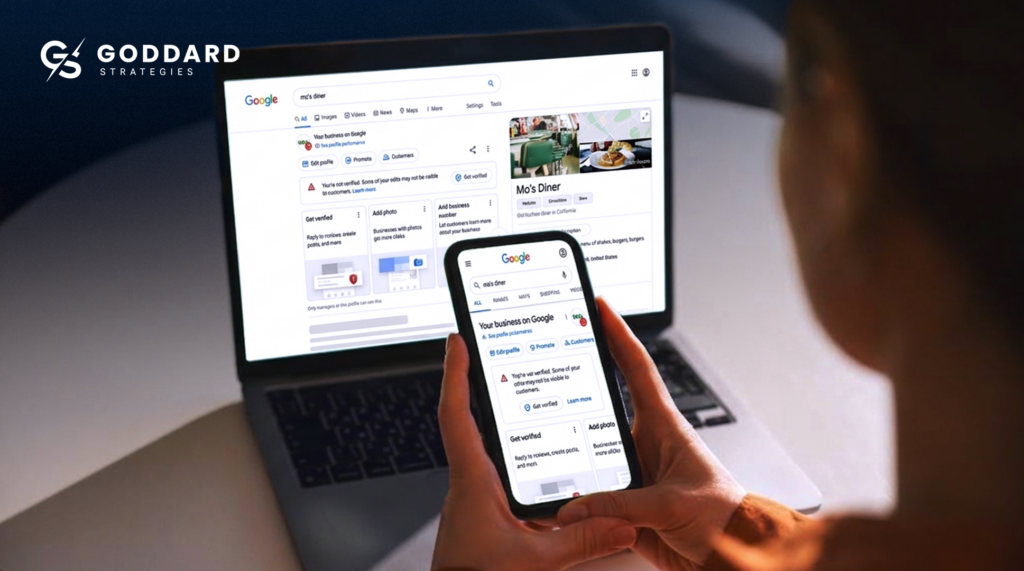
Does Google Business Profile help with AI recommendations?
Yes. A complete, accurate profile is one of the strongest and most direct signals about your category, location, services, and reputation, all of which feed the systems generating recommendations.
How can I make my business easier for AI search engines to understand?
Keep your business information consistent, describe your services in detail, publish content that answers real questions, and build mentions across trusted local and industry sources. Each step reduces the guesswork for AI.
Does local SEO still matter when people use AI search?
More than ever — the signals local SEO produces are the same ones AI relies on. See our guide to AI search visibility for local businesses for the full answer.
Let Goddard Strategies Make Your Business Clear to AI
AI search engines reward businesses that are clear about who they are, what they do, and where they do it. Goddard Strategies helps local companies build exactly that kind of clarity. We handle the service pages, the question-driven content, the consistent listings, and the local signals that turn your business into one an AI can confidently recommend, and we tie it all to measurable growth rather than guesswork. If you’d rather be the recommendation than the runner-up, call us at (317) 565 6069 or schedule a talk, and we’ll show you where to start.